Loading...
Back to Blog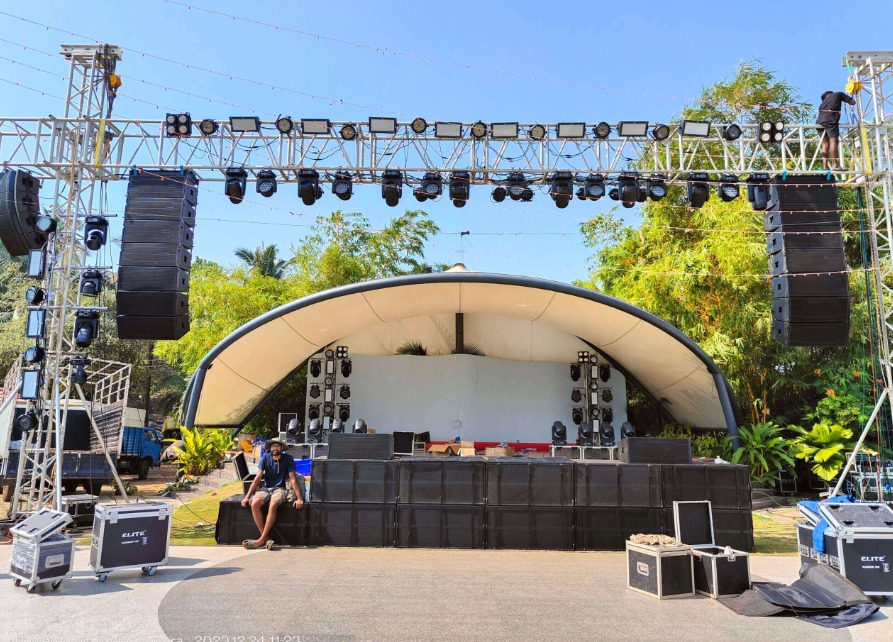
Sound
Line Array vs Traditional Speakers: Which Is Better for Large Events?
By admin
May 11, 2026
Sound can make or break an event. No matter how well the stage is designed or how strong the lineup is, bad audio ruins the experience for everyone in the room. For large events, the choice between line array speakers and traditional point-source speakers is one of the most consequential decisions in the production process.
At Candeia Events, this decision is made with precision for every project. The goal is always the same: consistent, clear, powerful sound across every corner of the venue. Understanding the difference between these two systems will help you see why the right choice matters more than most people think.
What Are Line Array Speakers?
A line array is a series of speaker cabinets mounted vertically, one on top of the other, working together as a single unified system. The array is engineered to project sound in a controlled, narrow vertical pattern while spreading evenly across a wide horizontal field.
How the Physics Work
Sound from a point source spreads in all directions, losing intensity the further it travels. A line array changes this behavior. When speakers are stacked and aligned correctly, their sound waves combine and reinforce each other. This creates a focused beam that travels farther with significantly less volume drop.
The result is that the audience member in the front row and the one 80 meters away both hear sound at a much more comparable level. That consistency is the defining advantage of line array technology.
Where Line Arrays Are Used
Line arrays are the standard choice for large-scale productions. You will find them at outdoor music festivals, stadium concerts, large convention halls, arenas and amphitheaters, and corporate events with 2,000 or more attendees.
The system scales up or down depending on the venue. More cabinets can be added to extend throw distance. Fewer cabinets can be used for mid-size indoor venues where some hang is still needed.
What Are Traditional Point-Source Speakers?
Traditional speakers, sometimes called point-source speakers, radiate sound outward from a single fixed point. A standard PA cabinet, a floor monitor, or a pair of full-range tops on stands are all examples of this format.
How They Work
A point-source speaker projects audio in a roughly conical pattern. Coverage is strongest directly in front of the speaker and falls off as you move to the sides or further back. To cover a wide space, multiple speakers are placed around the room, angled toward different zones.
Where Point-Source Speakers Work Well
Point-source systems remain the right tool for many situations. They perform reliably at small venues under 500 people, intimate corporate functions, breakout rooms and panel sessions, restaurants and private dining events, and compact outdoor setups.
The team at Candeia Events regularly deploys point-source systems for smaller activations where their simplicity and quick setup provide real practical advantages.
Line Array vs Traditional Speakers: A Direct Comparison
Sound Coverage
This is where the two systems diverge most significantly.
A point-source speaker covers a limited zone well. When the venue is large, multiple units are needed to fill the space. Each unit creates its own coverage area, and where those areas overlap, you get phase issues, uneven frequency response, and volume inconsistencies. Some sections of the crowd get too much bass; others get almost none.
A line array distributes sound evenly across the horizontal field. The vertical pattern is tightly controlled so sound is not wasted on the ceiling or the ground. Every seat in the audience receives a more uniform mix.
For a venue of 1,500 people or more, line arrays are almost always the correct choice for primary PA.
Throw Distance
Point-source speakers lose volume at a rate that follows the inverse square law. Every time the distance doubles, the sound pressure level drops by roughly 6dB. That is a dramatic fall-off in large rooms or outdoor settings.
Line arrays significantly reduce this effect. The coherent wavefront they produce holds volume over much longer distances, making them suitable for outdoor festivals, large amphitheaters, and elongated indoor spaces where the back of the room is far from the stage.
Intelligibility
Speech clarity is critical for conferences, awards ceremonies, and corporate presentations. Line arrays maintain high intelligibility at distance because the directional control reduces reflections and flutter echo. In a reverberant space like a sports hall or a ballroom with high ceilings, this makes a measurable difference in how clearly the audience understands the speaker on stage.
At Candeia Events, speech intelligibility is treated as a non-negotiable standard, especially for hybrid events where the in-room experience must match the streamed broadcast.
Setup and Logistics
Traditional speakers are faster and simpler to rig. A small system can be set up in under an hour with minimal crew. For single-day corporate functions, product launches, or private dining events, this speed has real value.
Line arrays require more time, more crew, and proper rigging points or ground-support structures. The tradeoff is justified for large events, but it is a genuine logistical factor that affects scheduling and budgeting.
Cost
Point-source systems are less expensive to rent and operate. For smaller events, the cost difference is significant, and the performance of a well-deployed point-source system is more than adequate.
Line array systems carry higher rental costs and require experienced engineers to tune and delay-align correctly. The equipment is only as good as the crew behind it.
When Line Arrays Are the Clear Answer
There are scenarios where line arrays are not just preferred but necessary.
Outdoor festivals and concerts have no walls to reflect and contain sound. You need a system that throws cleanly over long distances, and line arrays handle open-air environments better than any other format.
Large indoor venues with high ceilings, such as arenas and convention centers, benefit from the directional control that line arrays provide. Uncontrolled high-frequency energy bouncing off a hard ceiling creates a wash of noise that destroys clarity.
Events with a deep audience floor plan need line arrays to equalize the listening experience across the entire depth of the crowd. Hybrid and broadcast events also benefit, since line arrays reduce bleed and reflections and simplify the recording mix.
Candeia Events has designed audio systems for all of these formats. The recommendation is always based on venue geometry, audience size, and the nature of the content being delivered.
When Traditional Speakers Are the Smarter Choice
Not every event needs the complexity of a flown line array.
Private dinners and cocktail receptions are well-served by discreet, well-placed point-source speakers. Small conferences under 400 people in a standard hotel ballroom need nothing more than a two-box PA with a sub. When load-in is tight and the production window is short, a point-source system delivers fast, reliable results without compromise.
The Role of System Design and Engineering
The debate between line array and traditional speakers is secondary to system design. A poorly positioned line array with incorrect delay settings will sound worse than a thoughtfully deployed set of full-range tops.
Every great audio system starts with a room analysis. That means measuring the space, understanding the reflective surfaces, identifying the audience seating geometry, and then selecting the appropriate speaker format to match.
The engineers at Candeia Events use acoustic modeling tools to predict speaker performance before a single cable is pulled. This pre-production work is what separates a production company from a simple equipment rental house.
Delay and Subwoofer Placement
Delay fills are often needed in large venues to support the main PA for areas under balconies or in difficult acoustic pockets. These fills must be precisely time-aligned to the main system or the result is muddy, phasey low-mid frequencies.
Subwoofer placement also varies depending on the system. Cardioid subwoofer configurations are increasingly common on large festival rigs because they focus bass energy forward and reduce rear-stage spill, improving the experience for performers and crew.
What This Means for Your Event
If you are planning a large event, the audio system needs to be part of the conversation from the start. Trying to retrofit a speaker system into a venue after the layout is locked creates compromises that affect the final result.
The questions to ask early include how many people are attending and how the audience area is shaped, whether the venue is indoor or outdoor, what type of content will be delivered, whether there are broadcast or recording requirements, and what the rigging points and structural capacity of the ceiling are.
These answers determine whether a line array or a point-source system is the right foundation.
Candeia Events approaches audio design as an integrated part of the overall event production plan. Speaker selection, positioning, signal routing, and monitoring are all developed together with the stage design, power distribution, and scheduling.
Final Take
Line arrays are not always better. Traditional speakers are not outdated. Each system performs best in the right context.
For large-scale events, outdoor shows, and venues where coverage consistency is critical, line arrays set the standard. For intimate events, fast setups, and smaller audiences, point-source systems remain highly capable.
The deciding factor is always the event itself: its scale, its content, its audience, and its venue. That is the framework Candeia Events applies to every production.
Frequently Asked Questions
Can a line array be used for small events?
Rarely worth it. Line arrays solve problems small events do not have. A well-set-up point-source system performs better at lower cost.
How much more do line arrays cost than traditional speakers?
Typically two to four times more when factoring in rigging, crew, engineering, and equipment rental.
What happens if a line array is set up incorrectly?
Coverage breaks down, phase issues appear, and the sound becomes hollow and uneven. Correct alignment and processing are not optional.
Are line arrays better for outdoor or indoor events?
Both. Outdoors they solve distance. Indoors they control reflections. The venue size and content type determine which system fits.
How do I know which system is right for my event?
Audience size, venue shape, content type, and rigging availability determine the answer. Candeia Events can assess this for you.